Why AI Cannot Simply Be Bolted Onto the EMR
EMR’s (Electronic Medical Record) captures a wide variety of information from clinical encounters, patient information, diagnosis, medications, orders, clinical notes, supporting documentation, billing and other related...
SubstackRead original
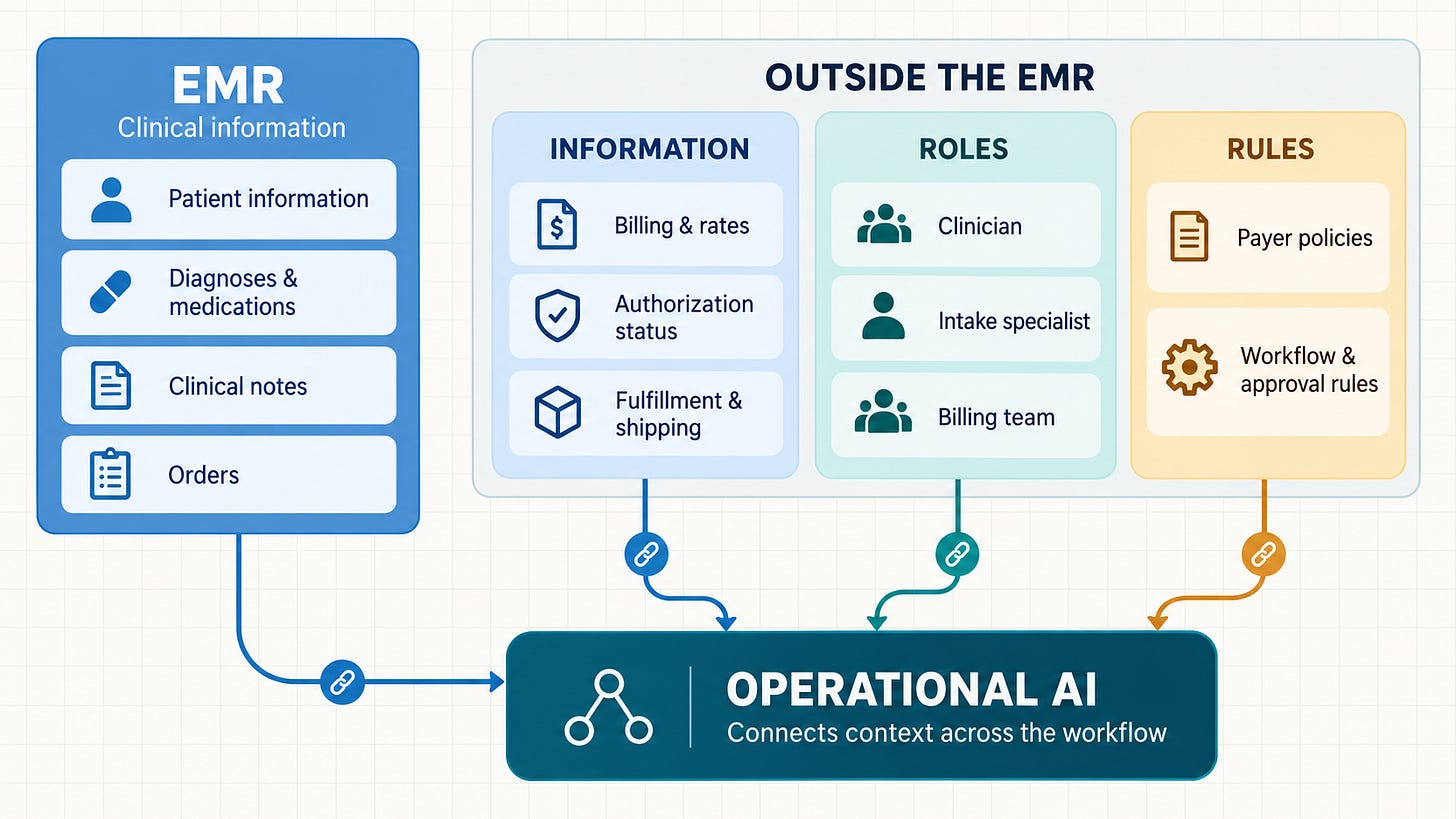
EMR’s (Electronic Medical Record) captures a wide variety of information from clinical encounters, patient information, diagnosis, medications, orders, clinical notes, supporting documentation, billing and other related information. Despite the essential nature & breadth of information in the EMR, it rarely contains the complete context to assess if an order and or service is operationally and financially ready.
Provider operations extends across workflows, documents, .policies, payers systems, people and financial outcomes. The EMR houses critical clinical information, but for AI to be meaningful and effective it needs to operate across the broader provider operations
Provider operations follow the order or patient journey and not bound by any system. Rather the workflow and information need to process the order/patient service traverses across EMR, EHR, Oder Management, Payer Portals, Clearing houses, billing systems, spreadsheets and much more,
AI has 4 jobs in provider operations
Automation is given, Operational AI must decide, co-ordinate , act & learn
As the decision engine it must determine
what orders are accurate
should the order proceed, be canceled
the financial risk
which payer requirements apply
The information to make the decisions may begin in the EMR but rarely ends there
Co-ordinate work across
intake to eligibility to claims to billing to shipping
Each of the stages in the workflow is spread across departments, information across sources, and multiple systems.
The role of AI is co-ordination on the work, while maintaining permissions, control & audit.
Act & Write
Identify missing information in orders, claims,
Updating an ordering, claims, invoice
Drafting patient, clinical, payer communications
Reading & summarization is start, but the values lie in action. This requires access, integrations, permissions beyond the scope of EMR co pilot.
Learn
Was the order & claim risk assessed appropriately
Why was the claim denied
What delayed the payment
By connecting action, outcome a learning loop is created, which establishes the baseline to improve operations
Operational AI requires context
All this requires more than information or a single source of information, it requires context. Context exists the beyond the boundary of one single system, it is spread across the workflow. It requires ability to connect data to process to the people to the outcomes and the influencing the reasons. In a provider operations this information is spread far and beyond an EMR.
DMEPOS order illustrates problem
An example of this i have encountered - When a new order is submitted for DME or POS service, the order arrives in one of many ways from a fax, to email, or entry to order management. The clinician notes, patient data are all head in the EMR however the decision on how to process the order is a combination of payer policies, bill rates, shipping all lie outside the EMR. It is quite possible that context for the order flow and clinical care is combination of systems, documentation, rules extend well beyond EMR. For the AI to be useful to the provider, it requires to operate in the reality of how work is done and not merely by documentation.
The question on hand is not whether AI lies in the EMR, outside the EMR or next to the EMR, rather what is required to make it work extends beyond a system of record. The EMR is source of record for clinical information and in cases billing information, however provider operations extend beyond. It requires intelligence that can bring clinical information, billing, payer information, payer requirements, payer behavior, documentation requirements, prior actions, outcomes
Provider operations is about decisions not documentation.